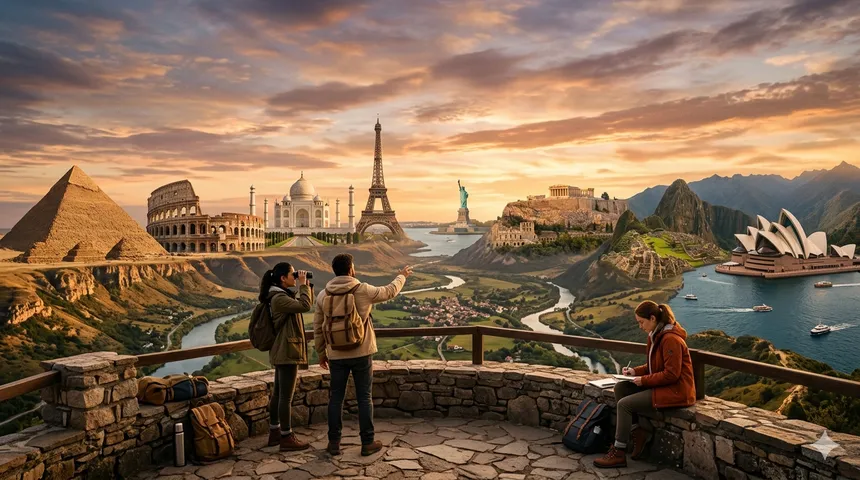
Europe Travel Guide
Europe's extraordinary density of history, art, architecture, and culinary tradition makes it the world's most visited region — and with good reason. Nowhere else can you stand in a Roman amphitheater in the morning, eat lunch in a medieval square, visit a Renaissance palace in the afternoon, and dine in a Michelin-starred restaurant in the evening, all within the same city. This guide covers the European regions that consistently deliver the richest experiences: Greece and the Aegean, the imperial capitals of Central Europe, Russia's two great cities, Scandinavia's fjords and design culture, Southern Italy and Sicily, and Croatia's Dalmatian Coast.
Greece & the Aegean Islands
Greece rewards travelers with an extraordinary layering of ancient, Byzantine, and modern culture that few countries can match. Athens is one of the world's great cities for historically engaged visitors — and the Aegean island archipelago provides a natural counterpoint of sensory beauty and leisure.
Athens deserves more time than most visitors give it. The Acropolis and the Parthenon remain genuinely stirring — a monument to human ambition built 2,500 years ago that still defines the city's skyline. The Acropolis Museum (opened 2009) houses the finest collection of Classical sculpture in the world in a building designed to frame views of the site itself. The Ancient Agora, the Temple of Olympian Zeus, Hadrian's Arch, and the National Archaeological Museum — whose collections span five thousand years of Greek civilization — fill multiple days without exhausting the city's depth.
The Aegean island cruise is one of Europe's great travel experiences. Delos (the mythological birthplace of Apollo, now an open-air archaeological site closed to overnight visitors), Mykonos (whitewashed windmills, labyrinthine alleyways, waterfront tavernas), and the incomparable volcanic island of Santorini — where the caldera-edge villages of Oia and Fira offer arguably the most spectacular sunset views in Europe — form the classic circuit.
Greece Cruise & Island Options
Central Europe — Budapest, Vienna & Prague
The three great capitals of Central Europe share a common Austro-Hungarian imperial heritage that manifests in grand boulevards, palatial opera houses, elegant coffee house culture, and a depth of musical and intellectual tradition unmatched anywhere in the world. The Danube connects them geographically and historically — and a river cruise through this corridor is one of Europe's most scenic and culturally rewarding journeys.
Budapest is divided by the Danube into two distinct halves: Buda (the medieval hilltop castle district, Matthias Church, Fisherman's Bastion, with sweeping views across the river) and Pest (the Great Market Hall, the vast neo-Gothic Parliament building, Heroes' Square, and the thermal bath culture that defines Hungarian city life). The Hungarian capital is one of Europe's most beautiful and most underrated cities.
Vienna is the cultural capital of the continent — the Kunsthistorisches Museum, the Schönbrunn and Belvedere palaces, the Vienna State Opera, and the Ringstrasse's remarkable architectural parade combine with the coffee house culture and concert hall tradition to create the most immersive single-city experience in Europe. A week in Vienna barely scratches the surface.
Prague is arguably the best-preserved medieval city in Europe, having escaped the bombing that leveled so many Central European cities in the Second World War. The Old Town Square and its astronomical clock, the Jewish Quarter (Josefov), Prague Castle, and the Charles Bridge at dawn before the crowds arrive — these are some of the continent's great travel experiences.
Danube River Cruises
Where to Stay in Central Europe
Russia — Moscow & St. Petersburg
Russia's two great cities offer a concentrated encounter with one of history's most powerful and culturally complex civilizations. The country's art collections, imperial architecture, and historical monuments are of a scale and ambition that places them among the world's greatest — and the cities reward unhurried exploration.
Moscow's Red Square — the symbolic heart of the country, flanked by the colorful onion domes of St. Basil's Cathedral and the severe red walls of the Kremlin — is one of the world's great public spaces. The Kremlin's Armoury holds extraordinary collections of Fabergé eggs, royal regalia, and Romanov-era carriages. The Moscow Metro, with its elaborately decorated Stalinist stations, is itself a museum of Soviet art.
St. Petersburg, Peter the Great's "window on the West," is one of Europe's grandest cities: a planned Baroque capital built on marshland in the early eighteenth century. The Hermitage Museum — housed in the Winter Palace — holds one of the world's three or four greatest art collections: Rembrandt, Rubens, Matisse, Picasso, and three million objects across six buildings. The Peterhof Palace and gardens, Catherine's Palace at Tsarskoye Selo, and a boat trip through the city's river and canal network complete a visit of extraordinary cultural density.
Where to Stay in Russia
Scandinavia — Fjords, Cities & Design Culture
Scandinavia offers a kind of travel experience found nowhere else: dramatic natural landscapes of extraordinary scale set against deeply sophisticated, design-conscious urban cultures. The region's combination of geological grandeur and cultural refinement creates a travel experience that is both stimulating and restorative.
Norway is defined by its fjords — the Geirangerfjord and Sognefjord, both UNESCO World Heritage Sites, are among the world's most dramatic landscapes. Bergen, Norway's second city, is a beautifully preserved Hanseatic trading port, and Oslo's Viking Ship Museum (a perfectly preserved ninth-century vessel) is one of Scandinavia's most moving exhibits. Sweden's Stockholm combines Gamla Stan (one of Europe's best-preserved medieval old towns) with the Vasa Museum and a design culture that has made the country globally influential. Copenhagen adds the Little Mermaid, Tivoli Gardens, and a dining scene (anchored by Noma and its progeny) that has transformed the city into one of the world's great food destinations.
Norway Fjord Cruises
Where to Stay in Scandinavia
Sicily & Southern Italy
Southern Italy and Sicily represent the Mediterranean at its most historically layered and culinarily exuberant. This is a region that has been successively shaped by Greek colonists, Roman rulers, Arab emirs, Norman kings, and Spanish viceroys — each leaving behind monuments and traditions that still define the landscape and table today.
In Sicily, Palermo's Norman cathedral and the extraordinary Byzantine mosaics of Monreale are among Europe's greatest medieval monuments. The dramatic clifftop theater of Taormina (with direct views of Mount Etna) is one of Italy's most photographed sites. The Valle dei Templi at Agrigento — a valley of Greek temples in a state of preservation that rivals anything on the Greek mainland — makes a compelling case for Sicily as the finest destination in Italy for archaeological travel.
The Amalfi Coast is one of Europe's most beautiful stretches of shoreline: vertiginous cliffside villages (Positano, Ravello, Amalfi itself), a boat excursion to the island of Capri, and visits to the Roman ruins of Pompeii and Herculaneum — two of the ancient world's most extraordinary time capsules, preserved under volcanic ash since 79 AD.
Where to Stay in Southern Italy & Sicily
Croatia & the Dalmatian Coast
Croatia's Dalmatian Coast is one of Europe's most strikingly beautiful destinations — a long limestone coastline studded with medieval walled cities, clear Adriatic water, and islands covered in olive groves and vineyards. Dubrovnik and Split are the anchors of any Dalmatian itinerary, and both reward extended visits.
Dubrovnik, the "Pearl of the Adriatic," is a medieval walled city of extraordinary architectural unity: marble-paved pedestrian streets, Gothic and Baroque churches, Renaissance fountains, and sea walls that can be walked in their entirety for panoramic views of the city and coast. Split is built literally inside and around the fourth-century Palace of the Roman Emperor Diocletian — apartments, restaurants, and bars occupy spaces that were once imperial vestibules and mausoleums. The result is one of the ancient world's most lived-in archaeological sites.
Island excursions to Hvar (lavender fields, Renaissance architecture, sailing culture), Korčula (claimed birthplace of Marco Polo, exceptional local wine), and the Elaphiti Islands provide contrasting encounters with the quieter, less visited side of the Dalmatian coast.
Croatia Sailing & Cruise Options
Europe Travel Notes
- Best general season: Late April–June and September–October offer pleasant temperatures, longer daylight, and fewer crowds than peak July–August. Scandinavia and Russia are best May–September.
- Museum pre-booking: Major museums (Hermitage, Uffizi, Acropolis) require advance reservations in peak season. Book at least 2–3 weeks ahead.
- Dress for churches: Covered shoulders and knees are required at Orthodox churches (Greece, Russia) and most Catholic churches (Italy, Croatia). Carry a lightweight layer.
- River cruising tip: European river cruises sell out 12–18 months in advance for popular seasons. Christmas market cruises (November–December) sell out particularly fast.