Africa Travel Guide
Africa captivates travelers in a way no other continent can. From the Big Five roaming the open savanna of East Africa to the surreal landscapes of Namibia's Skeleton Coast, from the cosmopolitan energy of Cape Town to the raw wilderness of the Okavango Delta — Africa is a destination of scale, drama, and profound natural beauty. For the culturally curious traveler, it also offers some of the world's most important human stories: ancient civilizations, the legacy of apartheid, the Maasai and other indigenous cultures living alongside one of the planet's last intact megafauna ecosystems.
This guide covers the four sub-regions that reward international travelers most richly: South Africa, the Kenya & Tanzania safari corridor, Botswana, and Namibia.
South Africa
South Africa is one of the world's most diverse destinations — geographically, culturally, and ecologically. Few countries pack so much into a single itinerary: one of the world's most beautiful cities, a UNESCO-listed coastline, world-class wine country, a compelling national history, and some of the continent's most accessible wildlife viewing.
Cape Town anchors any South Africa visit. The V&A Waterfront, the cable car ascent to the summit of Table Mountain, the Cape of Good Hope, and the colorful Bo-Kaap neighborhood form the core of a city that consistently ranks among the world's most beautiful. Day trips into the Cape Winelands — Stellenbosch, Franschhoek, Paarl — add extraordinary scenery and food and wine culture to the mix.
The Garden Route connects the Western Cape to the Eastern Cape through a spectacular stretch of coast, forest, and lagoon. Knysna, Plettenberg Bay, the Tsitsikamma National Park, and Oudtshoorn's ostrich country are the highlights of a drive that rewards those who take their time.
Kruger National Park is South Africa's — and arguably Africa's — most famous game reserve. The park's sheer size (roughly the size of Wales) and exceptional road network make it uniquely accessible. Two full days of game drives are enough to encounter lion, leopard, elephant, buffalo, and rhino — the Big Five — alongside cheetah, wild dog, giraffe, and zebra. The nearby private reserves (Sabi Sand, Timbavati) offer more exclusive experiences with off-road driving and walking safaris.
Johannesburg and Soweto provide an essential encounter with modern South African history. The Apartheid Museum is one of the world's most powerful social history museums; the Hector Pieterson Memorial and a walking tour of Soweto with a local guide bring the story of the anti-apartheid movement to life.
Where to Stay in South Africa
Kenya & Tanzania Safari
The safari corridor spanning Kenya and Tanzania is widely regarded as the greatest wildlife experience on earth. The scale of the wildlife, the quality of the light, the openness of the savanna — and the sheer emotional impact of watching a lion pride move across a golden plain — is unlike anything else in the natural world.
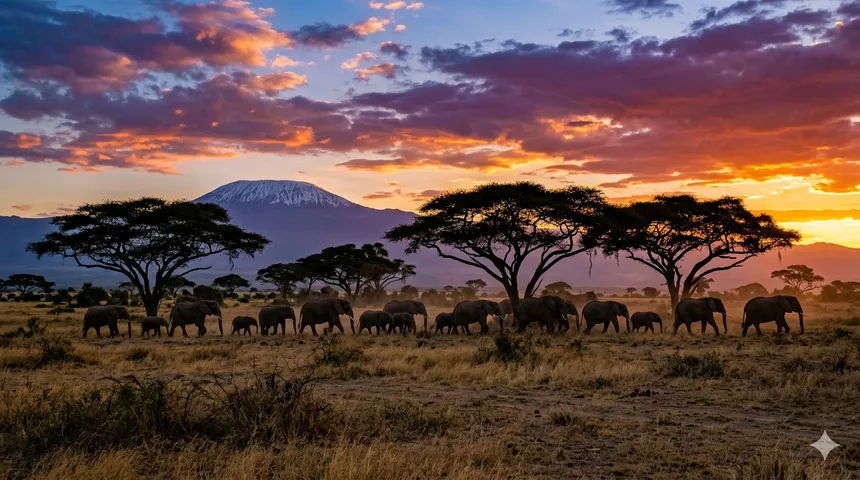
Amboseli National Park in Kenya offers one of Africa's most iconic images: elephant herds moving in the shadow of Mount Kilimanjaro, its snow-capped summit floating above the heat haze. The park is small enough to explore thoroughly in two days and is one of the best in Africa for close-up elephant encounters.
The Masai Mara is Kenya's most celebrated reserve and the northern extension of the greater Serengeti ecosystem. Between July and October, the Great Migration brings more than 1.5 million wildebeest and zebra across the Mara River in one of nature's most spectacular events. Outside migration season, the Mara is still among the finest game reserves in Africa for year-round predator sightings.
Crossing into Tanzania, the Serengeti offers vast plains supporting some of the highest densities of wildlife anywhere on the continent. The Ngorongoro Crater — a collapsed volcanic caldera that functions as a natural enclosure — concentrates wildlife in extraordinary numbers, including one of Africa's last stable black rhinoceros populations.
Where to Stay in Kenya & Tanzania
Botswana
Botswana is the gold standard of high-quality, low-impact wildlife travel. The country's commitment to conservation and deliberately low-volume tourism means visitors experience the bush in relative solitude — no traffic jams of minibuses, no crowds at waterholes. The trade-off is cost: Botswana is one of Africa's more expensive safari destinations, but the exclusivity and the quality of the experience consistently justify it for those who can make the investment.
Chobe National Park has one of Africa's largest elephant populations — estimates run to 130,000 animals — and extraordinary Nile crocodile and hippo concentrations along the Chobe River. Boat safaris on the river are among the best wildlife-watching experiences in Africa.
The Okavango Delta is the world's largest inland delta: seasonal flood waters from the Angolan highlands spread across the Kalahari to create a labyrinthine network of channels, lagoons, and islands teeming with life. Traditional mokoro (dugout canoe) excursions, guided bush walks, and night game drives are the signature activities. The Delta's remote camps are accessible only by small aircraft, which adds to both the sense of adventure and the exclusivity.
Where to Stay in Botswana
Namibia
Namibia rewards travelers who seek landscapes of epic, otherworldly scale. The country is vast, sparsely populated, and extraordinarily beautiful — a place where the light, the emptiness, and the sheer strangeness of the terrain create an experience unlike anywhere else in Africa.
The red sand dunes of Sossusvlei are among the tallest in the world, their crests glowing orange and crimson at sunrise and cooling to deep purple at dusk. The ancient dead trees of Deadvlei, standing bleached and skeletal against burnt ochre sand, have become one of the most photographed landscapes on the continent. Reaching the dunes at sunrise — before the heat builds and the light flattens — is one of Africa's great travel experiences.
Etosha National Park is a flat, pan-dominated ecosystem where waterholes become natural wildlife stages during the dry season. Lion, elephant, cheetah, black and white rhinoceros, and springbok converge at water sources in concentrations that make photography almost effortless. The Skeleton Coast — Namibia's cold, fog-shrouded Atlantic shoreline — adds a haunting maritime dimension: Cape fur seal colonies numbering in the hundreds of thousands, and the rusting wrecks of ships lost to the treacherous surf.
Where to Stay in Namibia
Africa Travel Tips
- Best season for East Africa: July–October for dry season and Great Migration river crossings; January–March for calving season in the Serengeti.
- Best season for Southern Africa: May–September (dry season) for South Africa and Botswana; Namibia is year-round but April–October is cooler and drier.
- Vaccinations: Yellow fever certification is required for entry into some African countries. Malaria prophylaxis is strongly recommended for East Africa and parts of Southern Africa. Consult a travel medicine clinic at least 6–8 weeks before departure.
- What to pack on safari: Neutral-colored clothing (khaki, olive, tan) is recommended. Avoid blue and black, which attract tsetse flies. Layers are essential as mornings and evenings in the bush can be very cold even in summer.
- Photography: A telephoto lens (200–400mm) is invaluable on safari. Most game drives allow photography from open vehicles, and experienced guides position vehicles for optimal light.